
This has been a long-standing debate among our clients and partners.
I once talked to this client who had applied the hull bottom paint to their propeller, no primer, no resin to prevent galvanic reaction. The paint cover went off in a blast after very little time. And after many tries over time, we had to conclude that there was no cheap and effective antifouling solution giving decent results on propellers. The key point is that regular bottom paint tends to wear quickly on a propeller, due to increased water friction.
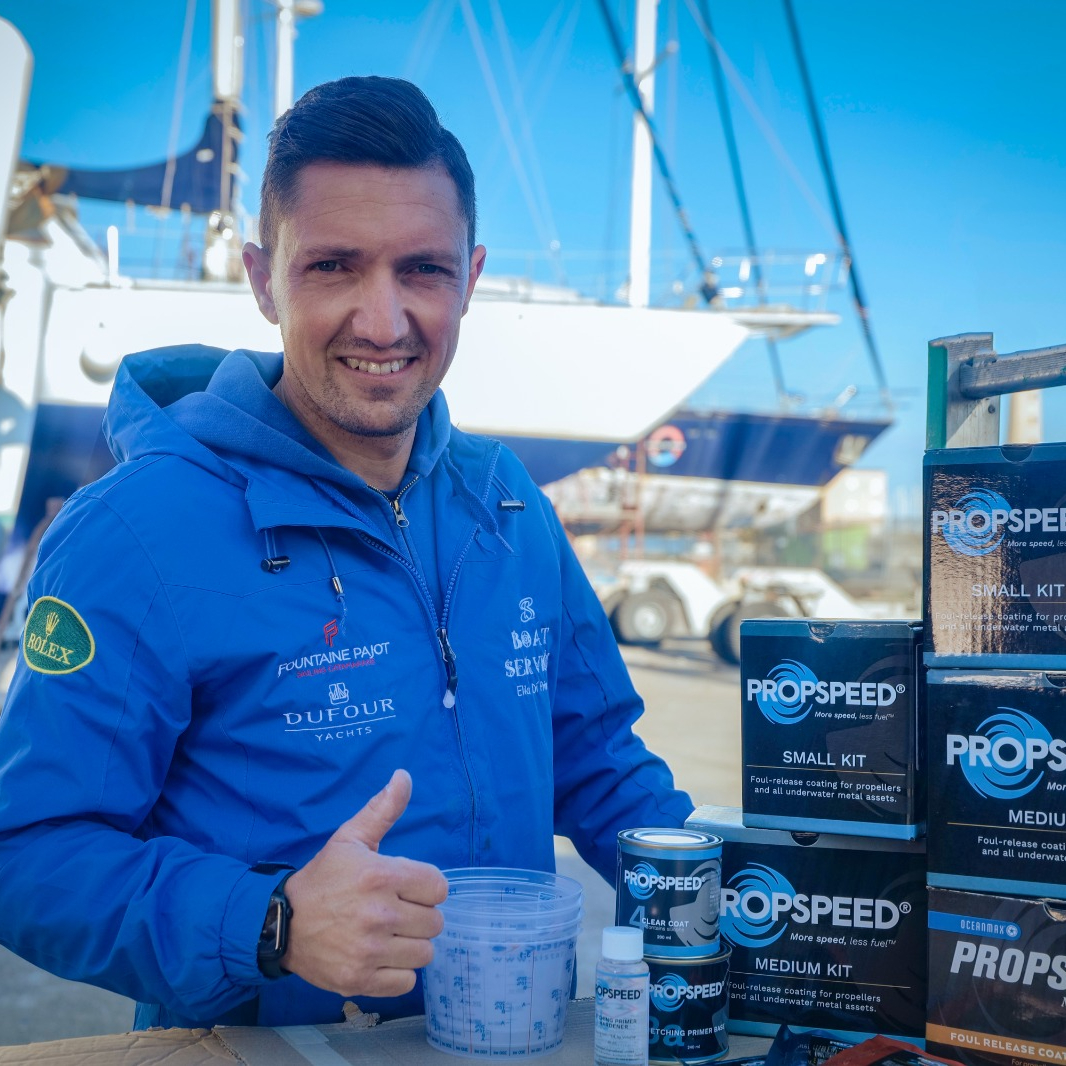
This is when we came across PropSpeed at a boat show, a more expensive solution, but also both more durable and efficient. One thing we particularly liked about it is that you didn’t have to re-start the whole process to repair a small damage. These can be locally sanded, clean and reapplied with PropSpeed solution (trying not to overlap, though).
PropSpeed discourage amateur application, and we went through their special training course to become qualified with their solution. One reason for this is that the coating process requires special process and care, and would usually involve two persons, as the time between yellow primer and Clear coat application is of the essence.
This is Daniele making a last sanding pass on the shining propeller of a Lagoon 450F.

Folding props are very delicate to work on and require special attention. Three-bladed prop needs to be completely removed to replace the sail drive anode. The assembly usually consists of 16 pieces, plus 1 saildrive anode, 2 bolts, 3 segmented hub anodes, and 3 Allen bolts. We mark each blade and hinge pin so that they are returned to their exact same spot.
Elia di Prima
There are some ungrateful boat work, hard, invisible to most. But working on a beautiful three-bladed folding bronze propeller, to bring it back to its mint condition isn’t one of them. We’re obviously both very proud of the result here.

And then PropSpeed Primer and Coat are applied. No time for process photos there, as we need to work fast through these two steps (see the vendor’s specifications bellow).

Of course we apply the coating according to the vendor’s specifications, and we went through their training course to get the qualification. Check it out here.
It is a pricey solution, but owners tells us it pays for itself pretty quickly into the sailing season, keeping the engine performance and fuel consumption at their nominal for extended time — and boy, did this become important with the fuel prices these days!
We can only trust their judgement here, and share with you the maker’s analysis. This performance chart is published on PropSpeed’s website as the testimonial of the owner of a Sea Ray 470 Sundancer.
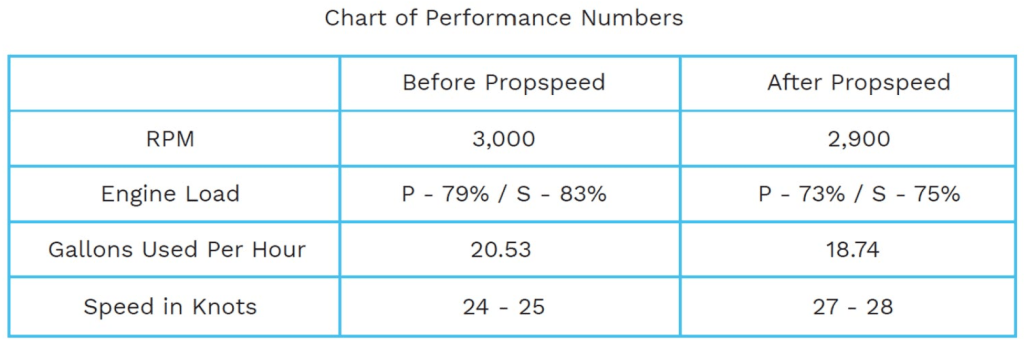
Of course we know there are no such things as “independent studies”. However, we are in a prime position to observe in what condition we get the propelling systems when the boats are hauled out for bottom cleaning and coating with antifouling.
I don’t usually endorse one product against another, and I’m always happy to share with other sailors what are their best experience. That’s how we improve things in the long run. Regarding PropSpeed, I must say I’m ready to commit a little more 🙂
With the fuel prices reaching sky-high levels these days, why don’t you contact me to discuss your projects?

 boatservicelicata.com